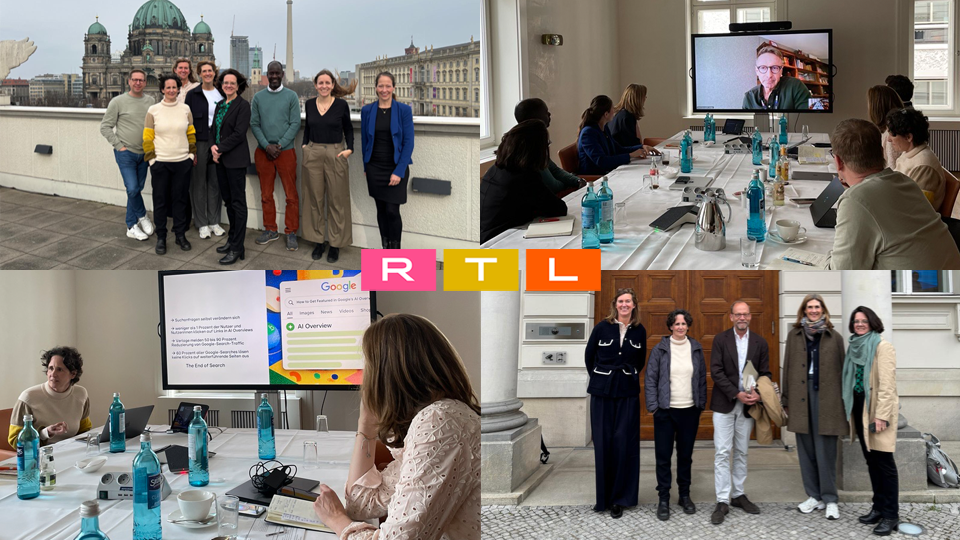
On 24 March 2026, colleagues met at the Bertelsmann representative office in Berlin to exchange on the evolving challenges facing press freedom and independent journalism during the latest ‘Freedom of the press’ working group meeting.
Sonja Schwetje, Chair of the working group, highlighted the importance of dialogue across RTL Group and Bertelsmann divisions: “The different perspectives in this group are a real strength as they help us to look at challenges in a more differentiated way and learn from each other.”
RTL Hungary: journalism and media freedom in a challenging environment
The meeting started with a contribution from Robert Kotroczó, News Director at RTL Hungary, who shared insights into the current media landscape in Hungary.
He described how, over recent years, the national media system has been significantly reshaped, with public media and communication increasingly aligned with government narratives. This has led to a challenging environment for independent journalism, where access to political representatives is often restricted and critical reporting can be marginalised.
At the same time, Robert highlighted the role of RTL Hungary as an independent player: “RTL is like a small island in Hungary.”
However, independent journalism comes with challenges. Often faced with restricted access to political stakeholders, journalists must find new ways to report: “The biggest problem is when no one from the government talks to you. We had to record everything and keep asking questions – even if there were no answers,” says Robert.
The discussion also pointed to generational differences in media consumption and political perception. While older audiences, primarily shaped by traditional television, tend to follow established narratives, younger generations are increasingly influenced by digital media and alternative sources.
Participants agreed that continuing to ask critical questions – even under pressure – remains essential for independent journalism: “The real freedom of the press is the freedom to ask questions.”
AI and journalism: shifting responsibilities
The impact of artificial intelligence on journalism and media business models was another central topic, presented by Cornelia Fuchs, Deputy Editor-in-Chief of Stern.
Cornelia outlined how search and user behaviour are already fundamentally changing: “We are already seeing what some call ‘the end of the search’.” She pointed out that AI-generated overviews are increasingly replacing traditional search results – with significant consequences for publishers: “Less than one per cent of users click on links in AI overviews, and publishers are reporting traffic losses of up to 90 per cent.”
AI-driven services such as Google Search, Google Discover and AI-generated summaries are changing the way audiences access information. This raises fundamental questions about the visibility of original journalism, attribution of sources and the sustainability of journalistic business models.
At the same time, AI systems heavily depend on journalistic content as their foundation: “AI relies on trustworthy journalism, with a significant share of its sources still coming from professional media.”
However, the way content is processed and presented raises critical concerns. AI-generated summaries often lack clear attribution or combine multiple sources in ways that can distort meaning or introduce inaccuracies.
The discussion highlighted the following question: who is responsible for facts and truth when AI merges different sources?
This becomes particularly relevant for investigative journalism, where context and accuracy are essential. Participants also noted that AI systems may struggle to correctly identify primary sources, increasing the risk of misrepresentation.
Content responsibility and creative freedom
From a content perspective, Pierrot Raschdorff from BMG outlined how the company approaches content-related decisions in practice.
The discussion highlighted the complexity of balancing artistic freedom and content responsibility. Given the diversity of artists and content, each case requires careful, individual assessment. While creative freedom for artists is broadly defined, internal processes help guide responsible decision-making. This approach is underpinned by four core principles: Artistic freedom comes first, context matters, no amplification of harm, and responsibility over neutrality.
BMG has introduced SafeSound, an AI-supported tool developed in-house to identify potentially sensitive content. The system searches for public controversies surrounding the artists’ lyrics; the lyrics and content are analysed against defined risk categories such as racism, sexism, and anti-semitism, and the results are presented in a structured format with potential risk indicators, to be subsequently reviewed, contextualised, and evaluated by the teams.
Pierrot summarises: “Content responsibility does not always come with clear-cut answers. It means applying consistent judgment, asking the right questions, and taking responsibility for the decisions we make.”
Legal perspectives: balancing press freedom and personal rights
Legal expert Simon Bergmann from the law firm Schertz Bergmann, which is known for representing high-profile cases in media law, provided insights into the tension between press freedom and personal rights.
He highlighted the increasing complexity of reporting in sensitive cases, particularly in the context of investigative journalism and allegations. Media organisations must ensure a sufficient factual basis and balanced reporting, especially when dealing with suspicions.
At the same time, he pointed to new challenges arising from AI-generated content and deepfakes, which raise questions about liability, verification and the protection of individuals.
Despite these challenges, Bergmann underlined the importance of press freedom as a fundamental pillar of democratic societies.
Shared commitment to press freedom
Across all discussions, participants agreed: press freedom is not a given, but an ongoing responsibility.
Whether facing political pressure, technological disruption or legal challenges, maintaining independent, balanced and responsible journalism remains essential.
As Sonja Schwetje, Chair of the working group, summarised: “It’s a fine line – reporting neutrally while withstanding pressure. What matters is that we don’t allow ourselves to be guided by political agendas.”
The ‘Freedom of the press’ working group will continue to serve as a platform for exchange, collaboration and shared learning across RTL Group and Bertelsmann.
Members of the ‘Freedom of the press’ working group:
- Sonja Schwetje (Chair of the working group and Managing Director & Head of Programming at RTL Nord)
- Oliver Fahlbusch (RTL Group)
- Cornelia Fuchs (Deputy Editor-in-Chief of Stern, RTL Deutschland)
- Rebecca Haase (RTL Group)
- Katharina Kleff (RTL Group)
- Barbara Kutscher (Bertelsmann)
- Rebecca Prager (Penguin Random House)
- Sabine Niemeier (Penguin Random House)
- Pierrot Raschdorff (BMG)
- Meike Rodenstein (RTL Deutschland)
- Gregor-Peter Schmitz (Editor-in-Chief of Stern, RTL Deutschland)
- Kirsten von Hutten (Bertelsmann)
- David Whigham (Editor-in-Chief of NTV, RTL Deutschland)
- Gernot Wolf (Bertelsmann Marketing Services/Arvato)