A recent reporting assignment on violence at railway stations sparked an intense debate for RTL Deutschland journalist Liv von Boetticher about press freedom and the role of journalism. After sharing her thoughts in a widely discussed social media post, we spoke with her about the importance of independent reporting, covering controversial topics, public trust in the media, and the challenges journalists face today.
1. In your recent social media post on X, you describe press freedom as one of the greatest achievements of a democracy. What does press freedom mean to you in your day-to-day work as a journalist?
Liv: Freedom of the press is an essential pillar of democracy. It gives everyone the opportunity to express their views freely, as well as to receive and share opinions.
In recent years, we’ve noticed that it’s becoming increasingly difficult to carry out normal journalistic work on the political fringes. In a democracy, you have to be able to tolerate different perspectives and opposing views. The moment we fail to shed sufficient light on relevant issues – perhaps out of concern that they might be misinterpreted or exploited for political reasons – something falls out of balance.
Freedom of the press is not something we can take for granted – it has to be protected and defended. I have travelled to many countries on behalf of RTL, and we are very fortunate to be able to work as we do in Europe. The last time I was in Afghanistan, our journalistic work was banned.
2. In your report, you describe an encounter with other journalists who questioned your team’s work or even sought to prevent it. Why did that moment affect you so deeply, and what did it reveal to you about current debates within journalism?
Liv: My team and I had been shadowing the Federal Police at work, reporting on violence at railway stations. The journalists who approached us and actively obstructed our filming objected to our reporting, accusing us of stigmatising people. The Federal Police officers had specific reasons for carrying out the checks and were simply doing their job. Nevertheless, they were accused of racial profiling, and we were accused of amplifying that through our reporting.
What troubled me was that the focus shifted away from the officers’ work and towards what journalists themselves consider newsworthy. In recent years, I have often had the impression that, in certain debates, we have become too cautious out of fear of stigmatising people. This concern is fundamentally important and justified. At the same time, we have to be able to report on developments when they are relevant.
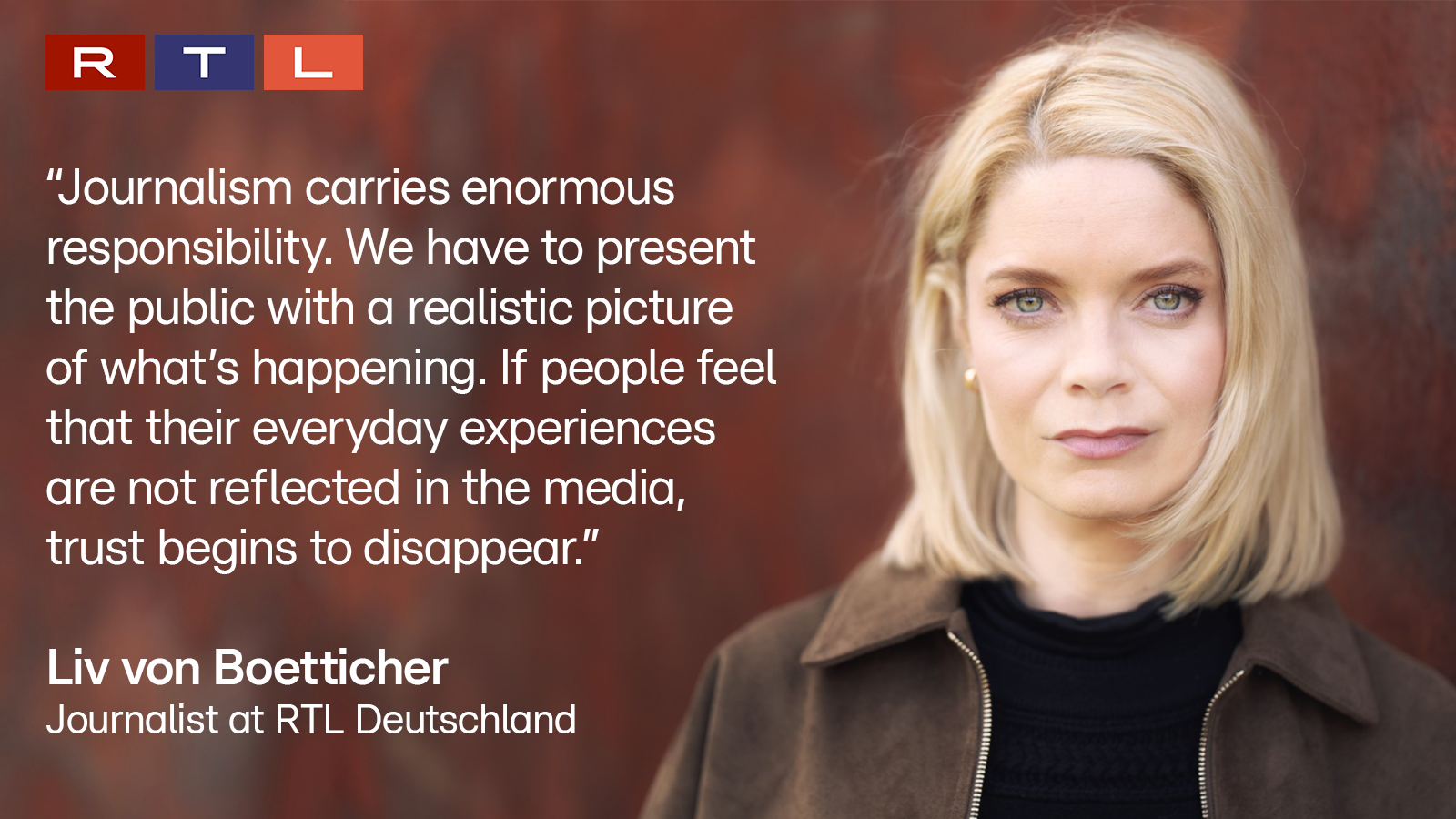
During this incident, I realised that, in some parts of the debate, a momentum of its own developed, causing the specific facts of the matter to be lost from view. Sensitivity must not lead to a reluctance to report the relevant facts. Journalism carries enormous responsibility. We have to present the public with a realistic picture of what’s happening. If people feel that their everyday experiences are not reflected in the media, trust begins to disappear.
There is a journalistic motto: ‘Tell it like it is’. I sometimes feel that we have lost sight of that principle in recent years. When personal convictions become too prominent, credibility suffers. Personal opinions must take a back seat to balance and facts.
3. Trust in the media is a frequently discussed topic. In your opinion, what can journalists and news organisations do to strengthen public trust in independent reporting?
Liv: We should listen carefully to what matters to people. Many issues that play a major role in people’s everyday lives are not necessarily the ones that concern journalists themselves the most. Our job is to engage with people and take their perspectives seriously.
Journalism does not have an educational mandate. It is not our job to tell people what they should think. Our job is to provide information and put developments into context.
In my view, problems have to be clearly identified. Otherwise, there is a risk that people will no longer feel represented and will turn to other sources of information. I made a conscious decision to work for RTL because, in my journalistic work, I have always been supported in addressing issues openly.
4. You argue that journalists should document reality – even when it is uncomfortable or controversial. How do you inform the public while also providing the necessary background and context, without oversimplifying complex issues?
Liv: Oversimplification would be the wrong approach, particularly when dealing with politically sensitive topics, because important aspects can easily be lost. At the same time, reporting shouldn’t overwhelm people.
In our report on the Federal Police, for example, we deliberately chose not to include all the available figures, as this would have overloaded the report. Television has the advantage of being able to communicate through images as well as words. At the same time, it is important to us to involve experts when covering socially relevant and controversial topics, so that developments can be put into context.
5. What worries you most about the future of press freedom and independent journalism – and what gives you reason for optimism?
Liv: My greatest concern is the growing coarsening of public discourse, which is also reflected in increasing violence against journalists. Last October, I was physically attacked for the first time while filming a report on social security fraud. I was attacked from behind, kicked in the kidneys and ended up in hospital.
Colleagues also report increasing attempts to disrupt their work. Sometimes it’s relatively harmless, such as people jumping in front of the camera or obstructing filming. But journalists are also physically attacked, pushed, have equipment snatched away, or are even pelted with stones. At demonstrations and during Cologne Carnival, we now work with security staff – that wasn’t necessary a few years ago.
What gives me hope, however, is that many media organisations are now engaging in intensive discussions about how to achieve balanced and credible reporting. I get the impression that, in many newsrooms, there’s a renewed focus on how to reflect different perspectives while staying connected to people’s everyday realities.