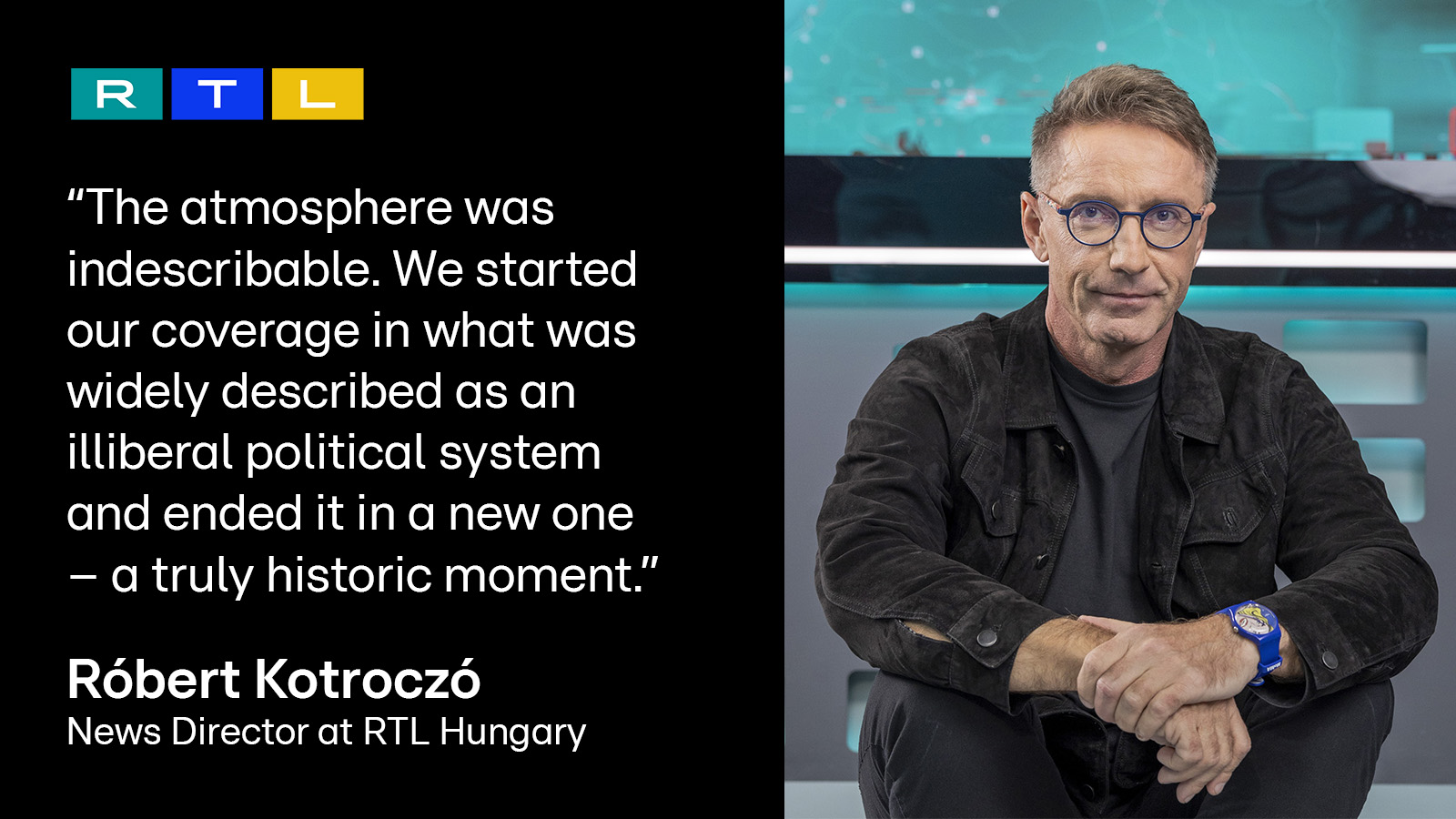
News Director Róbert Kotroczó takes us behind the scenes of RTL Hungary’s election night coverage.
Hungary’s recent election marked a historic political shift, bringing an end to Viktor Orbán’s years in power. On the night of 12 April 2026, RTL Hungary’s flagship channel RTL became the most-watched channel, as millions of viewers followed the results through its live coverage.
In this interview, Róbert Kotroczó, News Director at RTL Hungary, shares how the broadcast came together – covering the mix of formats, editorial approach and scale of preparation – and reflects on the return of Heti Hetes and the role of trust in such a high-stakes moment. His insights build on a recent interview with CEO Gabriella Vidus, who highlighted how RTL Hungary is navigating changes in the media landscape while continuing to grow its reach across both linear and digital platforms.
1. RTL Hungary offered a mix of formats on election night, from continuous news coverage to the return of popular talk show Heti Hetes (Seven Days, Seven Heads). How was this overall structure designed, and in what ways did the editorial approach or storytelling differ from previous election coverage?
Election days follow a strict legal timeline. We aired our regular news programme from 18:00 to 18:45, and then, from the close of polls at 19:00, we launched our live election coverage, presenting the results through graphics, studios, special guests and experts.
We began promoting the election programme well in advance and had already started building the profiles of our experts in our news shows last year. This first segment lasted half an hour, followed by the relaunch of the much-anticipated talk show Heti Hetes. From 20:45 until 01:30, we returned to our election coverage.
We felt that this election had the potential to be “historic.” There was also a strong sense of a generational divide, so our approach was to introduce two very young experts – one of them a woman – and gradually build their presence in our news programmes before the election.
We also featured two special guests. One was Endre Hann, Head of the Median polling company, who had been under attack by the government for predicting a two-thirds opposition victory. He accepted our exclusive invitation and analysed the incoming real-time data. The election results ultimately confirmed his forecast during our live coverage.
After 22:00, we also invited a well-known political analyst who is considered to be right-leaning, for balanced coverage.
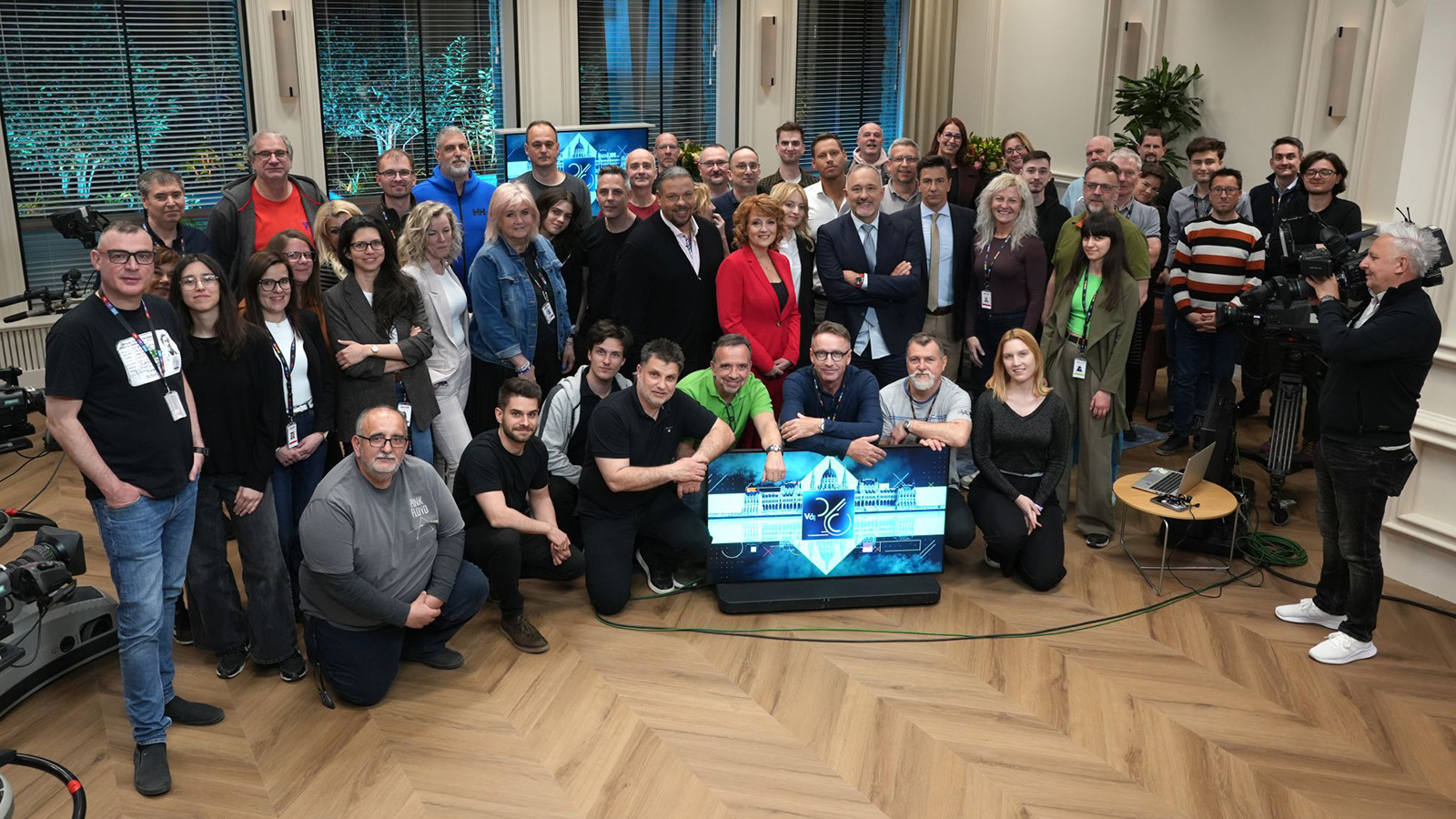
2. Can you give us a sense of the scale of preparation, the number of colleagues involved, and the energy in the newsroom and control rooms throughout the night?
Planning and preparation began last year, after the summer, initially with a small creative team. Over time, more and more colleagues became involved, and in the end, more than 100 people worked on the production.
It is also important to note that the long and intense campaign period leading up to the election contributed significantly to the atmosphere. There was a strong sense that more people than ever would be watching this election and this proved to be true.
During the live broadcast, there was of course a high level of focus and attention. As the results kept coming in, it became increasingly clear that the country would wake up to a new reality the next day. When Prime Minister Viktor Orbán called Péter Magyar to congratulate him on his victory, we also began receiving reports of spontaneous street celebrations across Budapest and in other cities, and we prepared to cover these live.
The atmosphere was indescribable. We started our coverage in what was widely described as an illiberal political system and ended it in a new one – a truly historic moment.
3. What were some of the key production or technological solutions that helped ensure everything ran smoothly?
In our production, we used extended reality in the news studio for the first time. For our results board, AI-powered visuals helped animate the main political contenders. As each key constituency was presented, the leading candidates appeared visually to provide viewers with updated results.
This had never been seen before on Hungarian television, especially not in a political context. We also operated more than 10 live locations, with crews and reporters both in Budapest and across the country.
4. RTL in Hungary was the most-watched channel on election night. What do you think were the key drivers behind this success?
Our consistent, independent news coverage over the past decades, and the strong credibility we have built, were key factors. Viewers also seem to appreciate our editorial judgment and storytelling.
5. Moments like election night put a spotlight on the role of trusted media. What does independent and credible journalism mean in practice for your team, and how do you ensure that trust is upheld?
It means a strong professional commitment, as well as strict ethical and editorial standards that remain consistent over time.

Oliver Fahlbusch
Executive Vice President Communications & Investor Relations, RTL Group
+352 / 24 86 5200
Irina Mettner-Isfort
Vice President Media & Investor Relations
RTL Group
+49 221 456 56410