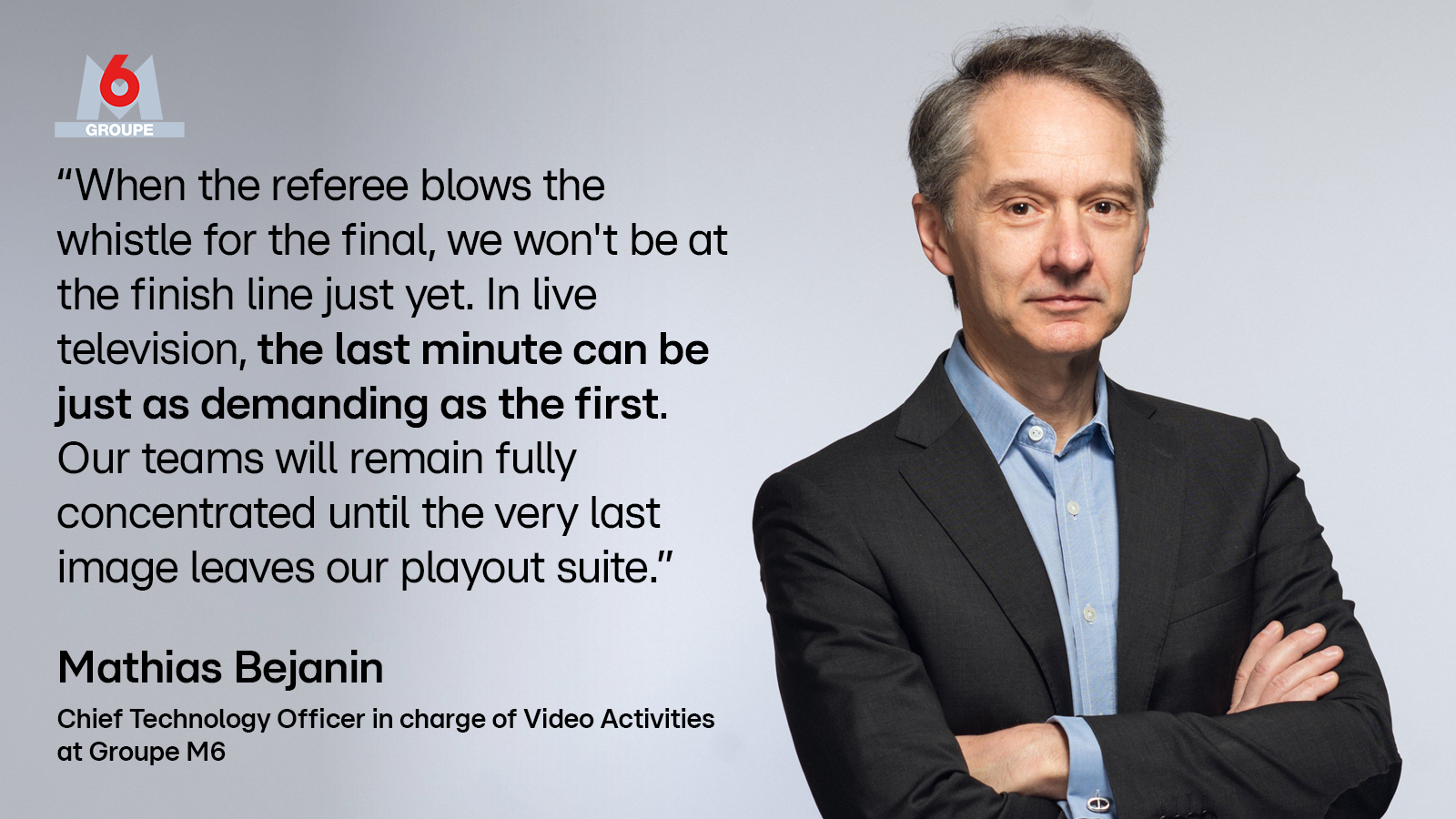
Teams in Dallas and Paris, secure transmission routes, backup systems and dozens of specialists ensuring each match reaches its audience without interruption: Groupe M6 has been preparing for the broadcast of the 2026 Fifa World Cup for over a year. Mathias Bejanin, Chief Technology Officer in charge of Video Activities at Groupe M6, was interviewed ahead of the kick-off on 11 June 2026. Read the full interview below!
1. For the first time in its history, Groupe M6 will broadcast 54 of the Fifa 2026 World Cup matches live, including the final. What does an event of this scale mean for the technical teams behind the scenes?
An event of this scale is both a tremendous opportunity and a great technical challenge. For our teams, it means months of intensive preparation to ensure that every single match reaches our viewers in the best possible condition – live, seamlessly and in high quality.
The project truly kicked off in March 2025, when we attended the first ‘World Broadcaster Meeting’ organised by Fifa in Dallas. That meeting was a real eye-opener: Fifa laid out the full scope of the tournament – the global organisation, the production principles, technical setup, signal transmission architecture, logistics, transportation… – and it immediately became clear that we were dealing with an event of exceptional scale and several major technical projects, most of which were handled internally by M6's engineering teams.
First, we had to build secure transmissions for all video and audio feeds. Matches are played in 16 stadiums spread across the United States, Canada and Mexico, with signals converging at the International Broadcast Centre (IBC) in Dallas. We built a technical system in a 45-square-metre space at the IBC, allowing us to select and transmit the right signals according to M6's broadcast schedule. The system is operated by a dedicated seven-person team on-site, selected from among our internal technical staff. Transmissions are made with a fibre connection from Dallas to Neuilly (Groupe M6 headquarters in Paris) and backed up by satellite transmissions for the international signal.
In Neuilly, we completely rebuilt and re-cabled our master control room to be able to handle the quantity of matches. We also developed software to automate master control room operations with a scheduler, meaning that the operator can prepare all the configurations (such as signal routing and audio mapping) in advance and activate these configurations throughout the day.
There is a lot of preparation for the day-to-day operations when the competition starts: Groupe M6 will broadcast up to three matches per day, every day! For each match, we open a continuity room where technicians and a backup commentator can take control if there is an incident resulting in a lack of signal from the site. And we are also producing a daily magazine, produced both in our internal studios and externally in a larger studio with an audience. This will create very busy days for all the technical staff involved.
2. When audiences watch a match, they mainly focus on the game itself. What are some of the invisible technical decisions and preparations that make a major live broadcast feel seamless?
To ensure a seamless experience, the most important factors are secure transmissions and backup processes. People probably imagine that broadcasting the World Cup is simply a matter of receiving a satellite signal and putting it on air. While this is technically possible, it would involve significant risks.
Therefore, we decided early in the process to have highly secured transmissions: 12 HD signals and four Ultra-HD (UHD) signals in fibre links to cover all our editorial needs, satellite downlinks for HD and UHD backups, and a continuity room with technicians and a backup commentator. For example, for the fibre links, we chose to have two different fibre paths main/backup, and on each path, there are redundant fibres. Every decision has been taken in favour of secure operations.
3. The World Cup coverage will extend across M6, M6+, RTL Radio (France), social media and digital platforms. How has the role of technical teams changed as football broadcasting becomes increasingly multi-platform?
Of course, digital platforms and social media have an increasing weight in our content distribution. The M6+ streaming service is operated by Bedrock and they have done considerable work to prepare for the World Cup: improving the performance of the app/site and the player, alongside performing load tests to ensure that the platform will be able to handle the ever-increasing number of connections.
On our side, we have worked to facilitate short-form productions for social platforms. There is a huge demand for immediate publication of posts (extracts, highlights, etc.) on various social networks and we needed to provide tools to ease production and automate some processes to be as fast as possible. We have chosen to work with Wildmoka for clipping, editing, posting and automatic generation of content. Configuration, training and rehearsals with the social media team were carried out in the spring and we had a final full-scale test covering the Champions League final on 30 May.
4. Can you give us a sense of the scale behind the operation? How many teams, systems and partners need to work together to deliver a tournament like the Fifa World Cup?
16 stadiums across three countries: the United States, Canada and Mexico. 48 teams, 104 matches in 39 days, 34 match days with only five days of "rest". M6 will cover 54 of the best matches among the 104.
Signals from all these venues converge at the IBC in Dallas, which itself is a city within a city: 56 broadcasters from around the world have a dedicated space there, totalling 15,000 square metres.
For the engineering work, I have a team of about ten people since last summer, dedicating over 50 per cent of their time to the various World Cup projects. For operations, there will be a seven-person team at the IBC. In Neuilly, between 30 and 50 technical staff will be mobilised every match day, depending on the match schedule and configuration. In addition, there are of course the anchors, commentators, consultants, journalists, social media teams, advertising sales teams and promotional teams.
For partners, the list is huge. Our biggest partner is Fifa and the technical host broadcaster, HBS, which arranges the production of matches on the venues, and operates the IBC. Other partners include Bedrock for M6+ and Telstra for transmission.
5. On 19 July at 21:00 (CEST), when the referee blows the whistle to kick off the World Cup final, millions of viewers will enjoy the match. What will be going through your mind at that moment?
Focus, first and foremost. Because when the referee blows the whistle for the final, we won't be at the finish line just yet. In live television, the last minute can be just as demanding as the first. Our teams will remain fully concentrated until the very last image leaves our playout suite.
Secondly, a growing sense of satisfaction and pride as the end approaches. Pride in the teams who have worked before and during the competition to achieve this event which is so important for Groupe M6.
And surely some fatigue! Because a World Cup is a marathon: 39 days of intense live broadcasting, in addition to all the preparation before, make this event quite exceptional.