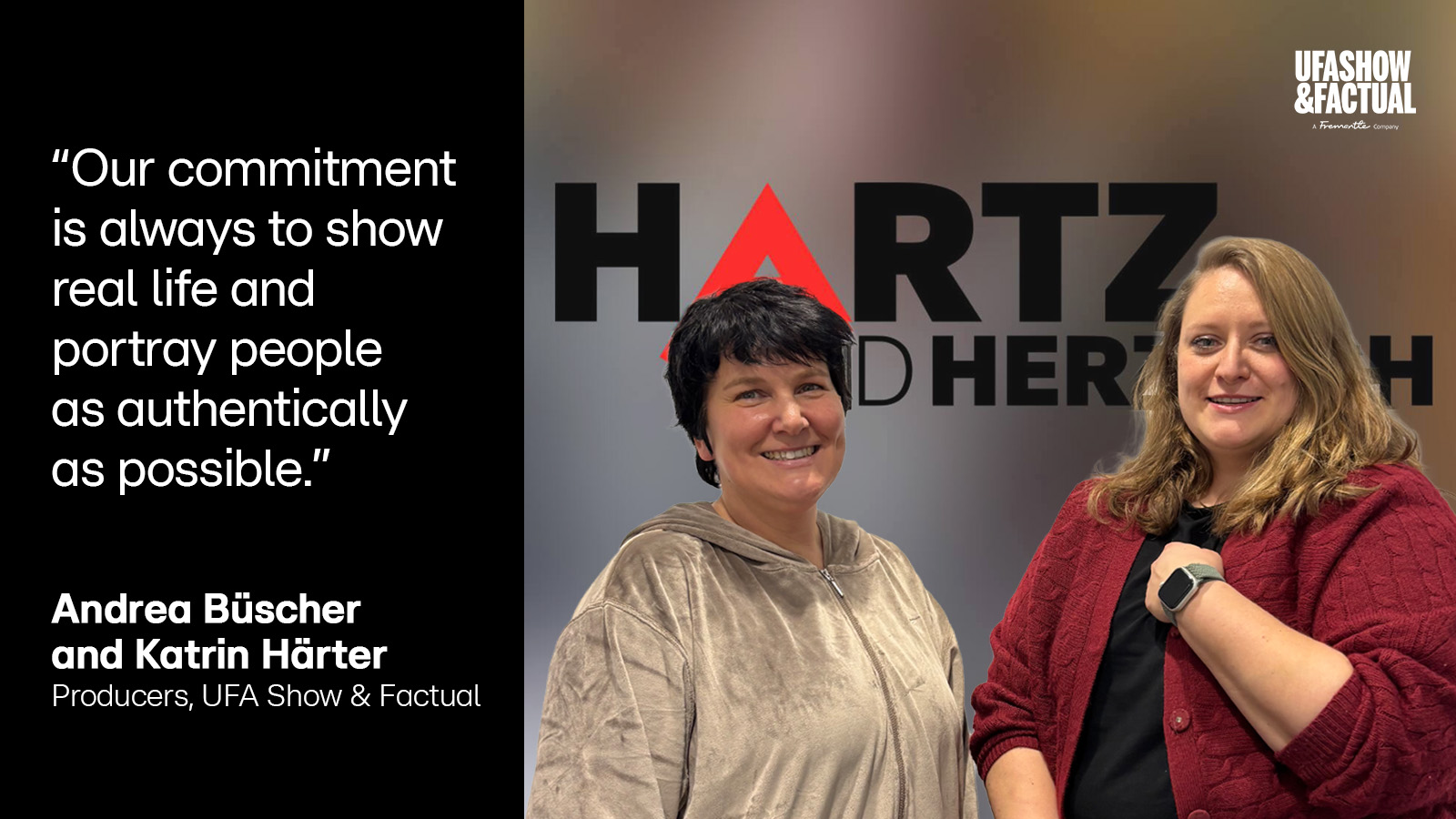
From 10 February, new weekly episodes of Hartz und Herzlich will air on RTL Zwei, turning the spotlight on people living in underprivileged neighbourhoods in Hamburg. As the UFA Show & Factual social documentary series celebrates 10 years on air, we spoke to producers Katrin Härter and Andrea Büscher about its enduring impact.
1. The first episode of Hartz und Herzlich was broadcast on 20 February 2016, and now, 10 years later, the series is one of RTL Zwei’s most successful format brands. Can you share the secret ingredient as to why German audiences have taken the series to heart?
The people we portray are, above all, warm‑hearted. And with their sense of togetherness, they overcome almost any obstacle. The success also lies in its long-term closeness: the series follows people over years, creating a genuine bond with the audience. Because it’s told up close, respectfully and without a script, it feels authentic – showing everyday life, setbacks and small moments of happiness.
2. More than 500 people from 20 different cities in Germany have been portrayed over the 700 episodes – and many of them have since become real-life celebrities. How can this attention affect the authentic storytelling?
The fact that so many of our protagonists receive such strong resonance shows how relevant and relatable their stories are. For us, however, this attention doesn’t change the way we tell stories. We don’t construct narratives – we observe and document what is there. Our commitment is always to show real life and portray people as authentically as possible.
3. Hartz und Herzlich depicts the realities of underprivileged neighbourhoods and people receiving social benefits. Can you share insights into how the format helps shape public opinion?
Hartz und Herzlich gives a voice to people who are on the fringes of society and whose realities are often overlooked. At the same time, the format presents examples that challenge common social stereotypes. This enables the audience to gain a more nuanced understanding of life at the subsistence level – and helps to shift perceptions of this part of society.
4. How do you imagine Hartz und Herzlich might look in 2036?
We would like to think that a show like this would no longer be necessary. But we believe that even in 2036, it will still be important to give a voice to people living at the subsistence level, because the gap between rich and poor is continuing to widen, even in Germany.
5. Do you have a favourite person or storyline that you would especially like to highlight?
One of the most wonderful things about the past ten years is that we’ve had the privilege of following so many wonderful people. That’s why it’s impossible to single out one favourite person or story. We were there for weddings, births, children starting school, funerals and family celebrations. We have laughed and cried with them. This decade has been an emotional rollercoaster – and we are grateful for every single moment we were able to share.
Oliver Fahlbusch
Executive Vice President Communications & Investor Relations, RTL Group
+352 / 24 86 5200
Irina Mettner-Isfort
Vice President Media & Investor Relations
+49 221 456 56410